Your Website Is Compliant. Tick. But Where Has Your Traffic Gone?
Concerned by the problem of having less analytics data if you make your website compliant?
Website compliance without blind marketing
Website privacy compliance can distort digital marketing measurement due to, correctly, configured consent platforms preventing non-essential analytics from tracking visitors unless they give permission.
You get a website compliant – objective #1 – but there is a consequence. It’s harder to assess and make sense of your analytics data – objective #2 – which might take a big dent.
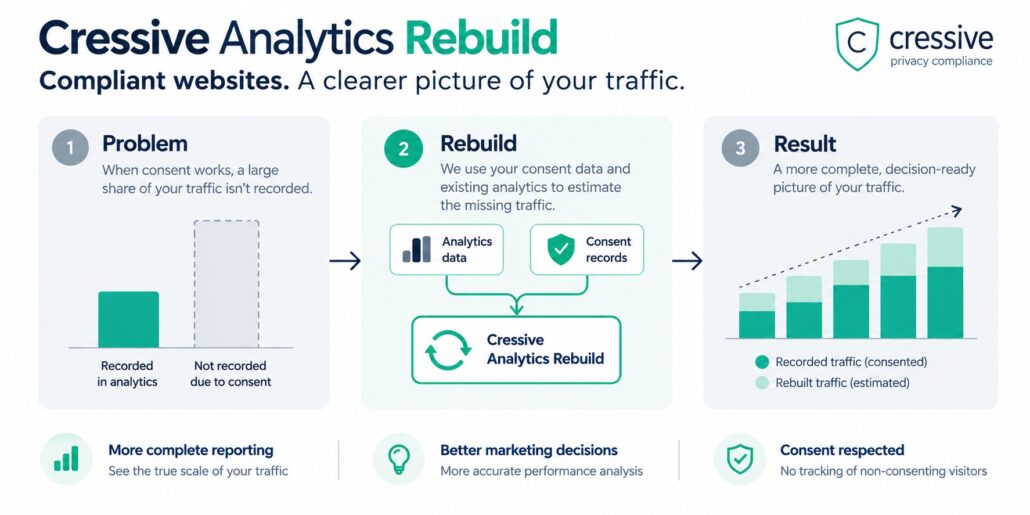
When visitors decline consent, their visits can go unrecorded in conventional analytics reports. The website hasn’t lost traffic. The marketing team only lost visibility of it.
How often do you decline cookies and tracking when you visit a website? Yeap, that’s you – you don’t get recorded, that’s your choice. But it leaves less for a Marketing manager to use.
They are responsible for acquisition, campaign performance, budgets and reporting, etc, this creates a problem: decisions possible only with the data available.
But, what Privacy Compliance might take away we can now giveth back with rebuilt analytics data, to address this problem.
The approach is grounded in observed consent decisions, rather than relying exclusively on predictions derived from the visitors analytics can already see. All above board.
It’s like Google traffic re-modelling without the minimum traffic threshold – ie. ours works. (And don’t similar to the ability of Google Search Console data to be unaffected by privacy.)
The process follows four stages: Clean, Model, Validate and Rebuild.
First, the data is cleaned to exclude automated traffic, testing environments, irrelevant consent records and out-of-scope markets; second, consent behaviour is analysed to calculate how much traffic may be missing, taking account of individual websites, countries, devices and consent experiences; third, the evidence is validated, with tracking coverage, consent configuration, data quality and sample sizes assessed before determining the reliability and detail of the projections; finally, we reconstruct aggregate traffic metrics, using the most appropriate available evidence from the analytics and consent platforms.
The marketing team gets data it can use, like before. And your website stays compliant.
The cliché ‘win-win’ is apt: rebuilt estimates of sessions, users and pageviews, with breakdowns by acquisition channel, country and device where the supporting data is sufficient, delivered through dashboards and APIs, allowing marketers to compare observed and rebuilt traffic and follow performance over time. And you’re compliant!
The objective is not to recreate individual events, identify visitors or reconstruct their journeys, but is to restore a more complete, decision-useful picture of website traffic.
And importantly, the system reports limitations and confidence warnings where the available evidence does not justify a more detailed result.
As organisations improve consent enforcement, the gap between actual website activity and recorded analytics WILL become more significant, and this affects acquisition reporting, SEO performance analysis, paid media evaluation, market comparisons and the interpretation of traffic trends.
A reduction in reported visits can reflect a change in consent enforcement rather than a change in customer demand. Without this knowledge, marketing decisions risk being based on misleading comparisons.
Remember when your traffic dropped when you implement cookie banners? (well, if the consent worked correctly. That’s what we can address.
Designed for marketing managers, digital analytics teams and organisations operating consent-compliant websites, particularly those managing multiple brands, markets or platforms. We support GA4, Adobe Analytics and Matomo, with consent data from platforms such as OneTrust and TrustArc, subject to integration and data availability.
Unlike approaches tied to a single analytics platform (you know the one) this is designed to work across different technology environments and provide visibility into its modelling inputs, factors and exclusions. Our solution has no significant minimum traffic per month. (Spoiler: Google remodelling needs 10k visits per month.)
More complete reporting, better-informed marketing decisions and greater confidence in the figures being used, while preserving the consent choices made by visitors. Available now.
Privacy compliance and effective marketing measurement should not have to work against one another.
Keep consent, and Rebuild visibility.
Cressive Analytics Rebuild (CAR) is part of Cressive’s Digital Performance and Digital Privacy.